

Rehabilitation
Acupuncture
Acupuncture is the insertion of very fine needles through the skin at defined points, usually left in place for fifteen to thirty minutes. It comes from traditional East Asian medicine and is used in contemporary practice mainly for persistent musculoskeletal pain. It is among the more heavily studied complementary treatments, and what the research supports is both real and narrower than what is often claimed for it.
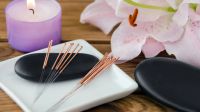
What a session involves
-
The needles
Sterile, single-use, and far finer than an injection needle — closer to the thickness of a hair. Insertion is felt as a brief prick, or not at all.
-
Placement and dwell time
Points are chosen for the problem being treated, some near the painful area and some distant from it. The needles stay in place for fifteen to thirty minutes while you lie still.
-
Stimulation
Needles may be rotated by hand, or connected to a device delivering a mild electrical current — electroacupuncture. Both are intended to increase the stimulus rather than to change what is being treated.
-
A course, not a session
Any effect accumulates over repeated treatments. A course of six to ten sessions is a normal trial, after which it is reasonable to decide whether it is worth continuing.
What it is used for
-
Persistent low back and neck pain
The largest body of evidence is here, and several major guidelines list acupuncture among the non-drug options for chronic pain in these regions.
-
Myofascial pain
The points used frequently coincide with trigger points. Dry needling, which comes from a different tradition and uses a similar needle, targets them explicitly.
-
Knee osteoarthritis
Studied more than most other joints, with results that favour it modestly over usual care.
-
Tension-type headache and migraine prevention
Among the better-supported non-musculoskeletal uses, generally as a preventive measure rather than a treatment for an attack in progress.
What the evidence shows
-
Better than no treatment, by a modest margin
Compared with usual care or a waiting list, courses of acupuncture produce small to moderate reductions in chronic pain that persist for some months.
-
The comparison with sham is the difficult part
When real acupuncture is compared with sham needling — shallow insertion, or needling away from the traditional points — the difference is small. Whether that means the specific points matter less than supposed, or that sham needling is itself an active treatment, is genuinely unsettled.
-
It is not a treatment for compression
Weakness, numbness or a nerve root under pressure is a structural problem and needs to be assessed as one. Acupuncture addresses pain, not the cause of it.
Safety
Serious complications are rare when it is performed by a trained, licensed practitioner using single-use needles.
-
Common and minor
Small bruises at needle sites, brief soreness, and occasionally lightheadedness or drowsiness for an hour or so afterwards.
-
Rare and serious
Puncture of a lung is the most serious reported complication, from needling over the chest or upper back. It is rare and depth-dependent, which is why training matters more than technique.
-
Tell the practitioner
Blood thinning medication, a bleeding disorder, a pacemaker or other implanted electrical device, a suppressed immune system, or pregnancy all change what is appropriate.
Common questions
Does it hurt?
Insertion is usually barely felt. A dull, heavy or spreading sensation around a needle once it is in place is common and is not a problem. Sharp or increasing pain is not expected and should be mentioned.
How many sessions before I know?
Six to ten. If a full course has produced nothing at all, continuing it is unlikely to change that.
Is it safe with blood thinners?
Usually, with lighter technique and fewer needles, but it is a decision for the practitioner to make knowing the medication and the dose. Bruising is more likely.
Is dry needling the same thing?
The needle is the same. The reasoning is not: dry needling targets trigger points identified by examination, and comes out of Western musculoskeletal practice rather than from traditional point systems.
General reference information, and not advice about your own case. It may not reflect the most recent guidance or what is offered on a given day — call (201) 408-5151 to check.
Schedule an appointment
Dr. Yoo Rehab Clinic welcomes new patients from across Northern New Jersey and New York City, including Englewood, Teaneck, Fort Lee, Palisades Park and Ridgefield. Call today to learn more about insurance, scheduling, and how we can help.