

Injections
Joint and soft-tissue injection
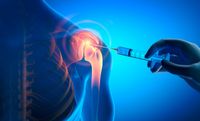
An injection of medication — most commonly a corticosteroid with a local anaesthetic — placed into a joint space, a bursa, a tendon sheath or another soft-tissue target. The corticosteroid reduces local inflammation; the anaesthetic provides immediate but temporary relief and, when the pain settles straight away, helps confirm that the injected structure was the source. The same procedure serves different purposes depending on the target.
Common targets
What is injected and what can be expected of it differ considerably by site.
-
Inside a joint
Knee, shoulder, hip and smaller joints, used for osteoarthritis and inflammatory arthritis, and for adhesive capsulitis where an early injection may shorten the painful stage.
-
Into a bursa
The subacromial bursa at the shoulder and the trochanteric bursa at the hip are the most frequent, generally where pain is limiting rehabilitation.
-
Around a tendon or in its sheath
Used selectively. Injecting into tendon substance is avoided, as corticosteroid can weaken tendon tissue.
-
Other soft-tissue targets
The carpal tunnel and the plantar fascia are treated with the same technique, each with its own considerations about repetition.
The procedure and the role of guidance
Accuracy varies considerably by site, and it determines both effect and safety.
-
Preparation
The skin is cleaned and, depending on the site, anaesthetised. The injection itself usually takes under a minute.
-
Image guidance
Ultrasound allows the needle and the target to be seen throughout. Studies of unguided injections at several sites show a meaningful proportion do not reach the intended target.
-
Immediately afterwards
Anaesthetic often gives relief within minutes, wearing off after some hours. The steroid effect typically develops over several days, which is why a brief return of pain in between is expected.
Risks and limits
The main considerations are the frequency of repetition and the effects of corticosteroid beyond the injected site.
-
Post-injection flare
A temporary increase in pain in the first day or two occurs in a minority of people and settles on its own.
-
Local effects
Thinning or lightening of skin and loss of fat at the injection site can occur, more often with superficial injections. Tendon weakening is the reason injections into tendon substance are avoided.
-
Systemic effects
A temporary rise in blood glucose is common and matters for people with diabetes. Facial flushing occurs in some people.
-
Infection
Rare but serious. A joint that becomes hot, swollen and increasingly painful in the days after an injection needs urgent assessment.
-
Limits on repetition
The number given in a year is limited because of cumulative effects on cartilage and soft tissue. Injections that provide progressively shorter relief usually prompt a change of plan rather than another injection.
Common questions
How long does the relief last?
Highly variable — from weeks to several months depending on the site and the condition. It is generally used to enable rehabilitation rather than as a treatment in its own right.
Why did the pain come back after a few hours?
That is the local anaesthetic wearing off. The corticosteroid takes several days to take effect, so a gap between the two is expected.
Do steroid injections damage the joint?
Repeated intra-articular corticosteroid has been associated with cartilage changes in some studies, which is why frequency is limited. A small number of injections is generally considered low-risk.
Is guidance always necessary?
Not for every site — some large joints can be entered reliably by landmarks. It matters most for small or deep targets, and where a failed injection would be interpreted as a failed treatment.
General reference information, and not advice about your own case. It may not reflect the most recent guidance or what is offered on a given day — call (201) 408-5151 to check.
Schedule an appointment
Dr. Yoo Rehab Clinic welcomes new patients from across Northern New Jersey and New York City, including Englewood, Teaneck, Fort Lee, Palisades Park and Ridgefield. Call today to learn more about insurance, scheduling, and how we can help.