

Injections
Trigger point injection
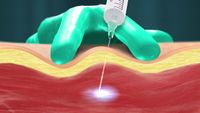
A trigger point is a discrete, tender nodule within a taut band of muscle which reproduces a person’s pain when pressed and often refers it elsewhere. A trigger point injection places a small volume of local anaesthetic — sometimes nothing but the needle itself, in which case it is called dry needling — directly into that point. The aim is to interrupt the cycle of muscle tension and pain for long enough that stretching and strengthening can proceed.
When it is used
It is a treatment for muscle pain specifically, and is not a general-purpose injection for a painful area.
-
Identified trigger points
Where examination finds a taut band with a tender point that reproduces the familiar pain, most often in the neck, shoulder girdle and low back.
-
Pain limiting rehabilitation
Where muscle pain and guarding are preventing the stretching and strengthening that would address the underlying problem.
-
Alongside other treatment
Commonly used with physical therapy and with treatment of whatever is loading the muscle, rather than as an isolated intervention.
What the procedure involves
A brief outpatient procedure, often performed at the same visit as the examination that identified the point.
-
Locating the point
The muscle is palpated to find the taut band and the point that reproduces the pain, and the area is cleaned.
-
The injection
A fine needle is inserted into the point. A brief local twitch is common and is generally taken as confirmation that the right spot was reached.
-
Afterwards
Soreness at the site for a day or two is usual. Stretching the treated muscle and returning to normal movement are usually advised rather than rest.
What the evidence shows
The literature is mixed, and being clear about that is part of using the treatment sensibly.
-
Comparable results with and without medication
Several studies have found dry needling produces similar outcomes to injecting anaesthetic, which suggests much of the effect relates to the needling itself.
-
Short-term benefit
Evidence is strongest for short-term pain reduction. Durable benefit depends on what is done in the window that creates.
-
Not a standalone treatment
Where the load or posture that produced the trigger point is unchanged, recurrence is common. This is the most consistent finding in the literature.
Common questions
What is the twitch I felt?
A local twitch response — a brief involuntary contraction of the taut band when the needle reaches the trigger point. It is expected and is generally regarded as a good sign.
How is this different from acupuncture?
The needle may look similar, but the target differs: a trigger point injection is aimed at an anatomically identified point in a specific muscle, while acupuncture follows a different system of point selection.
How long does it last?
Variable. Some people get lasting relief, others a period of improvement. Duration depends substantially on whether the contributing load is addressed.
Are there risks?
Soreness and bruising are common and minor. Site-specific risks exist for injections near the chest wall, which is why technique and anatomy matter.
General reference information, and not advice about your own case. It may not reflect the most recent guidance or what is offered on a given day — call (201) 408-5151 to check.
Schedule an appointment
Dr. Yoo Rehab Clinic welcomes new patients from across Northern New Jersey and New York City, including Englewood, Teaneck, Fort Lee, Palisades Park and Ridgefield. Call today to learn more about insurance, scheduling, and how we can help.