

Neck and back
Herniated disc
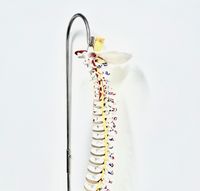
Intervertebral discs sit between the vertebrae and consist of a tough outer ring around a softer centre. A herniation occurs when the outer ring weakens or tears and the inner material is displaced outward. The displaced material itself is often painless; symptoms arise when it reaches a nerve root leaving the spine, which is why the pain is usually felt in the arm or the leg that root supplies rather than in the back or neck itself.
Presentation
Where the pain travels indicates the level
Cervical herniations refer symptoms into the shoulder, arm and hand; lumbar herniations into the buttock, leg and foot. Each nerve root serves a defined territory, so the path the symptoms take is the most useful single piece of information in identifying the level involved.
- Pain travelling into one arm or one leg, often in a band
- Numbness or tingling in the area one nerve root supplies
- Weakness in the specific muscles that root controls
- Aggravation with sitting, bending, coughing or sustained postures
Causes and risk factors
Herniation is usually the end point of gradual change rather than a single event, even when the symptoms begin suddenly.
-
Age-related disc degeneration
Discs lose water content and elasticity with age, which makes the outer ring more susceptible to tearing under loads it previously tolerated.
-
Mechanical loading
Lifting with a flexed and rotated spine, repetitive bending, and prolonged sitting are commonly associated. A herniation often becomes symptomatic during an ordinary movement rather than an exceptional one.
-
Trauma
Falls and vehicle collisions can produce or aggravate a herniation, which is one reason a new radiating pain after an accident is examined rather than attributed to bruising.
-
Individual factors
Smoking, obesity and a family history of disc disease are each associated with increased risk.
Diagnosis
The purpose of the assessment is not to find a herniation but to establish whether a herniation is what is producing the symptoms.
-
History and physical examination
Reflexes, power and sensation map to specific nerve roots. The examination generates a working hypothesis that any subsequent test is measured against.
-
MRI
The imaging test that shows disc material and neural structures most clearly. Herniations are also found in a substantial proportion of people with no symptoms, so the finding is interpreted in context rather than on its own.
-
Electrodiagnostic testing
Electromyography and nerve conduction studies measure nerve function directly. They help distinguish a nerve root problem from a nerve compressed further along the limb, which is a different diagnosis with different treatment.
Common questions
What is the difference between a bulging disc and a herniated disc?
They describe different degrees of the same process — a bulge is a broader, more uniform extension of the disc margin, while a herniation is a more focal displacement of material. Neither term establishes that the finding is causing symptoms; that is determined by whether it corresponds to the examination.
Can a herniated disc heal on its own?
Frequently. Herniations commonly shrink over months, and symptoms often improve before any change is visible on imaging. This is part of why non-surgical treatment is generally attempted first.
Should I avoid exercise?
Not usually. Activity that clearly aggravates symptoms is modified, but general inactivity tends to prolong stiffness and weakness. Which exercise is appropriate depends on the level involved and the stage of symptoms.
Does a herniated disc always cause pain?
No. Herniations are found on imaging in many people who have no symptoms at all. The finding matters when it corresponds to the pattern of a person’s symptoms and examination.
General reference information, and not advice about your own case. It may not reflect the most recent guidance or what is offered on a given day — call (201) 408-5151 to check.
Schedule an appointment
Dr. Yoo Rehab Clinic welcomes new patients from across Northern New Jersey and New York City, including Englewood, Teaneck, Fort Lee, Palisades Park and Ridgefield. Call today to learn more about insurance, scheduling, and how we can help.